The record begins with the chaos of that day.
Before the city gate drums could sound three times, people swallowed their screams. Spear tips fell to the ground, and ministers clutched prayers backward. Without exception, humans lost strength in their legs and crumpled down.
It arrived with the cold.
Though its form was human in appearance, no one could believe it was human. Its overwhelming presence devoured and crushed everything. Just its existence before their eyes was suffocating. And behind it, countless tree spirits—Dryads—were gathered in dizzying numbers.
Only then did the humans realize. That it was that famous calamity god, ‘Levia Rishian.’
It held out a boy. A body hanging limp without consciousness. The king rushed over practically tumbling down the stairs and received him with both arms. The king’s knees knelt first.
It handed the boy to the human king and said: This child’s name is Raha, take good care of him. If you do, it would grant whatever they wished. It seemed about to leave, but perhaps finding them unreliable, it returned.
The returned it—no, Levia Rishian looked down at the king’s wrist and smiled while lightly covering the child’s head with the hem of its garment.
“Just in case, I’ll tell you again. Feed him well and let him sleep warmly. If he cries at night, you must hold him, and if he scrapes his knee, put medicine on it. You mustn’t hurt him. Understand?”
Levia tapped a finger on the child’s forehead.
“And… no one can bully him. Really can’t. I’m scary when I’m angry. I’ll scold very, very severely. Very, very. So that won’t happen, right? Hmm?”
Levia Rishian looked around the castle once and said:
“Did everyone hear? This child is one I’m entrusting to you. Preciously. Promise.”
Instead of answering, the king nodded twice. People finally breathed. Some pressed their foreheads to the ground, some closed their eyes. When Levia Rishian turned away, the ash that had been falling outside the castle scattered like rain only above our heads.
The seasons that followed were recorded.
Nights when other countries’ rivers froze in midsummer, the sparse frost on our roofs, water flowing freely again at dawn. Prayers to be saved, petitions to stop, requests to postpone dates—they stuck to paper and disappeared.
What was granted was recorded sacredly. What couldn’t be granted was posted earlier the next day. People agreed. The child given to us was proof. A guarantee directly handed over from the ancient god who brings calamity, a receipt of promise.
But the person in question, Raha himself, doesn’t know himself. The first page of his memory is empty. However, his body knows first. The strength to endure weight, the path to let prayers through, the response of rising again after falling. He doesn’t know the fact that the vast power Levia Rishian distributed is holding up his weak body.
Still, a strange reverence clings. He knows nothing, yet he shines.
People called him ‘the human entrusted by god.’ More briefly, god’s incarnation.
Small pedestals appeared even in houses without altars, and on night roads children stepped aside and crouched down. Adults bowed their heads. Even those who didn’t kneel couldn’t keep their gaze long. When Raha stood, noise decreased. Blessings, transactions, and resentments lined up in a single row.
On some days illness was cured, on some days dates were postponed. Not everyone received miracles. So they came earlier the next day. Because they believed responses came from him.
And people see his face.
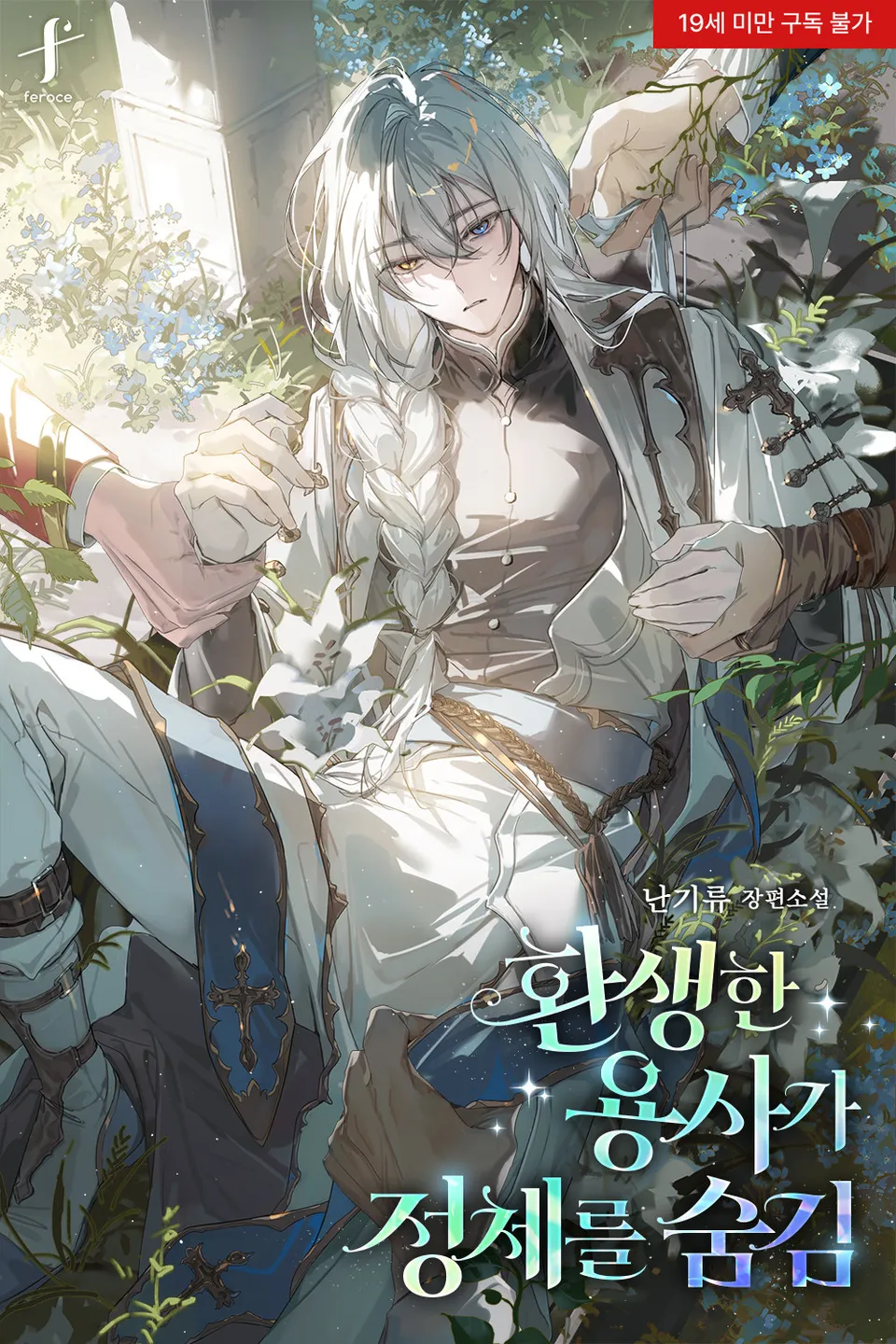
Raha possessed beauty close to perfection. His hair was white like a snowy landscape, his skin white and fair. If he received light for long, he shone like glass, and in shade he seemed to cool immediately. His eyes were violet. Too transparent to call purple, they held light of their own. The color between midnight and dawn. If you looked long, a small blur remained on the retina, and if you looked askance, ripples swayed first. The fine blood vessels on the back of his hand revealed themselves like a single sentence then hid. His breathing was quiet and long.
His beauty wasn’t personal possession. It was a marker. A testament confirming with the eyes the fact that god had directly entrusted him. Children learned that color was right. Strong men looked at that color with longing. Elders said that color was a color ‘that came to us.’ So people believed.
This face wasn’t inborn chance but the form of covenant. Because of that appearance, or thanks to it, Raha received divine veneration. Each time they saw him, the fact that we survived was proven once more.
He was close to perfect. But not complete. A very quiet trembling remained. That trembling was his weakness and the place we could cling to. A gap in perfection. In that gap, space was created for faith to enter. So people served him like a god while also embracing him as human.
***
The door opens late, and preparations start earlier.
From dawn, priests wipe the corridors and line the doorframes with cloth. They spread thin rugs on the floor so footsteps don’t echo and wrap bells on door handles. People lower the ends of their words. Today too, Raha is served as god’s incarnation.
Raha doesn’t walk alone. A sky-blue canopy creates shade, and differences in the road level are filled in advance. Priests step half a pace ahead to set the speed.
“The sunlight is strong today. Let’s go slowly.”
Raha nods. In front of stairs, he extends his hand first. There are rules even for touching. Don’t touch without permission. When you must touch, ask three times and wear gloves.
Raha always says it’s fine, and thank you.
There’s an order even for eating and drinking. There’s a separate kitchen for Raha, and the tray only comes up after a priest who tasted first says there’s no problem. Water is heated to a set temperature, and the first sip is always received while seated.
“Is the temperature all right?”
“Yes, thank you. It’s very good.”
His cup and towel are raised to the altar again before being replaced with new ones. What’s left over doesn’t return to anyone’s hands. Because it’s a marker.
Clothing and sleeping arrangements are also carried out like rituals. Raha’s fabric uses only fine-textured white, and seams are hidden twice. His hairbrush is used once, washed in water, and dried in shade. The bed’s number of blanket layers changes with each season, and the incense changes every night.
“You were a bit cool yesterday, weren’t you?”
“I was fine with one more layer added. Thank you.”
Raha answers everything with gratitude. That manner of speech is gentle, and people learn that gentleness as holiness.
There are rules for audiences too. Don’t call his name loudly first, don’t exceed three questions, crying is permitted but when holding hands receive the priest’s permission. When the line gets long, priests speak instead. Then people step aside and wait quietly. Waiting also became part of worship.
This is how Raha has lived.
Ridiculously, this was just rules humans decided on their own. ‘Utmost care’ must have been like that to them.
The person himself didn’t care at all. What was important to Raha was only obtaining faith and the fullness from it.
When everything is prepared like this, the temple’s great door opens. The sanctuary is already full of people.
“Just today, just an audience today….”
“Please just listen to one word.”
The sound of knees and foreheads touching the stone floor spreads like waves. Raha sits on a low pedestal in the center of the hall, and priests put wishes written down into boxes and stack them beside him. Those requesting to meet come forward one by one. Some put the paper they held back in their breast. Because speaking aloud seemed like it would reach better.
Raha said with a benevolent smile on that sacred face:
“Today please only do blessings up to the second row.”
A murmur sways once then settles.
“Don’t call names loudly, and please say the endings inwardly.”
Someone in the front row asks. Raha shakes his head very slowly.
“But can you still hear?”
“Of course. Just as I have until now.”
When a priest hands over a prayer book, Raha strokes the cover and asks what they will pray for. People are prone to shedding tears even before starting.
A priest lowers the lamp, and the crowd matches their breathing. Raha raises both hands together. A single name rises in his mouth and rolls slowly. In that moment, something taut wells up from inside Raha’s chest. He doesn’t know the reason. His body knows first.
It continues until night. People gather to Raha to make wishes, pray, and sometimes half-madly praise.
Sometimes excessive petitions come up.
“Return the dead….”
Raha sits for a long time before putting down the brush.
“This doesn’t come from me.”
“Then from whom….”
Raha shakes his head.
“It’s not an answer I know. Still, let’s pray together. If that’s a comfort.”
Children pass through the corridor only at permitted times, in permitted numbers. When the gatekeeper makes them slow down, Raha can’t hide a smile seeing the children.
After finishing everything like that, when night comes the door closes and priests bring the boxes of paper gathered during the day into the room. Raha opens the box lid and skims what he can read first. On some pages ink has bled, on some pages the endings are empty.
In the margins, Raha writes the same name once more. Levia Rishian. The space between letters narrows then widens. The paper slowly absorbs the ink and begins to cry shallowly. Raha doesn’t know why he writes it so much.
Just when he’s writing, everything became whatever.
Just containing its name made his chest boil over and his head cook. He became like a fish floating belly-up on the water. Anyone would know this was strange and dangerous, but for Raha, that was rather everything.
Everything was willing. Raha was completely bewitched by the god who remained only as a name. Without even knowing why, knowing only that it was natural.
In that moment, Raha whispers low:
“Did you see?”
If someone asked who saw, Raha would have no answer. Still, the words come out.
“Did I do well?”
Only silence. Raha accepts that silence like a response. And smiles. He doesn’t know the reason. The smile comes first.
Raha’s day ends like this. Just before sleeping, he calls the name once more in a voice he doesn’t share with anyone. Ecstasy arrives first, and when ecstasy passes, only the name remains. Raha puts that name under his pillow. Folded in paper, very small.
And forgets. Though he forgot, he rejoices again the next day. Again, he doesn’t know the reason.
“Your existence makes me happy.”
Raha doesn’t know it. But he knows. It’s nonsense but it’s true. It is an ancient god, a calamity of reality. But to us, it’s blessing and miracle. Raha is its incarnation and proof.
Though Raha himself can’t even remember it.
Where on earth does this ecstasy and rapture come from? Even so, Raha couldn’t erase the feeling of hunger somewhere. Even though everything was full.